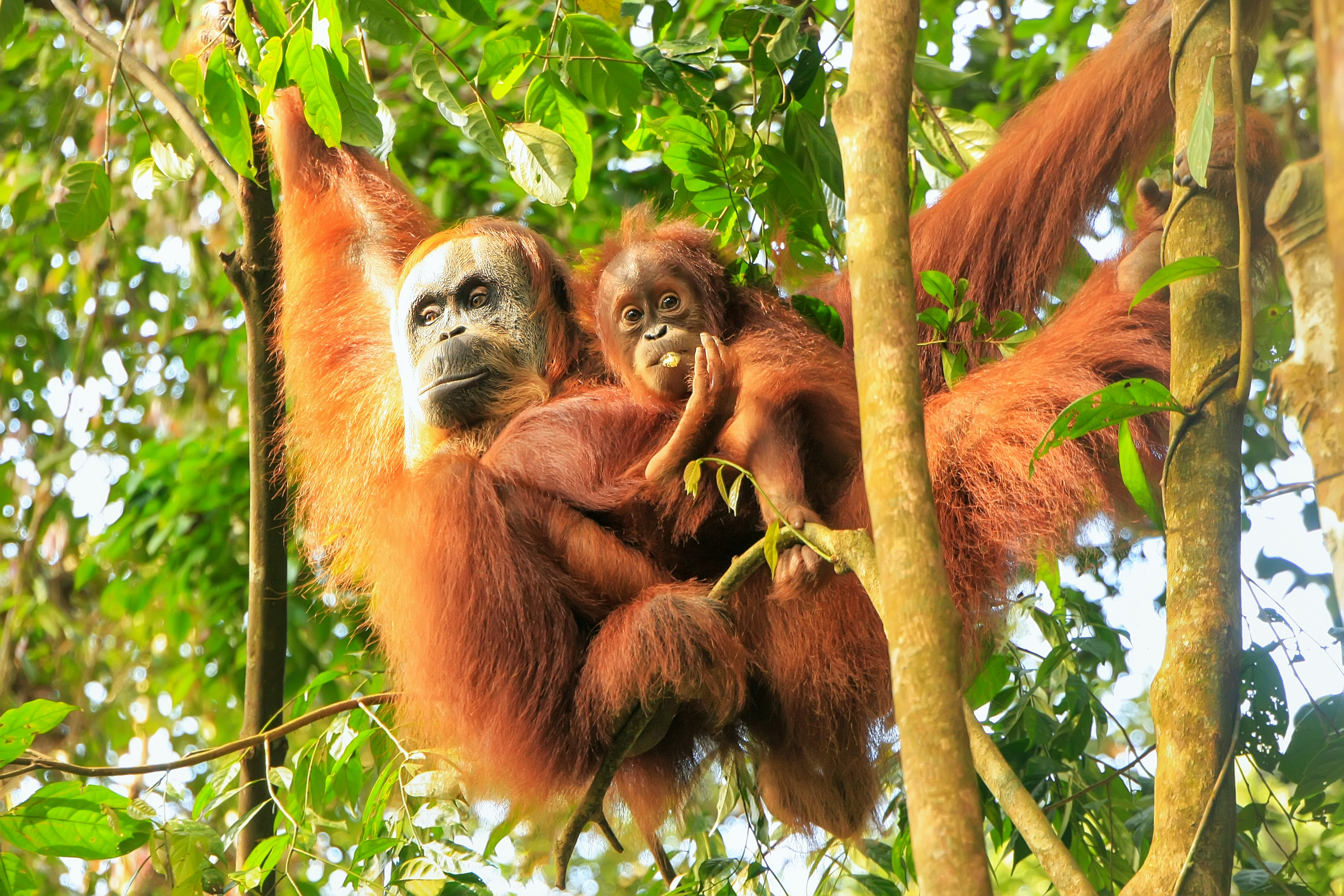
Female Sumatran orangutan with baby — Leuser National Park © Donyanedomam | Dreamstime.com
The Leuser Ecosystem is one of the most biodiverse places on Earth and the last place where Sumatran orangutans, rhinos, elephants, and tigers coexist in the wild. Decades of logging, palm oil expansion, and encroachment have degraded large areas of lowland and peat-swamp forest across the region.
This project focuses on restoring degraded lowland rainforest through community-led reforestation, agroforestry buffer zones, and anti-encroachment patrols. The Leuser Conservation Forum works directly with eight villages surrounding Gunung Leuser National Park, combining ecological restoration with livelihood development.
Interactive map with satellite data. Toggle between street map and Sentinel-2 imagery.
Normalized Difference Vegetation Index (NDVI) comparison showing forest recovery across the project area.
This project has been independently assessed across five dimensions of conservation quality and organizational integrity.
Multiple independent frameworks validate this project's conservation claims and organizational quality.
Quarterly updates from the Leuser Conservation Forum, produced by Arvela.
Two new community nurseries were established in Lesten and Agusan villages, bringing the total to 12 active nurseries producing over 500,000 native seedlings annually. The nurseries now grow 34 native tree species selected for their ecological value and growth rate.
Wildlife camera traps recorded three Sumatran orangutan families using the restored corridor between sectors 2 and 3 for the first time since restoration began. This is a significant milestone, as corridor connectivity is critical for long-term population viability.
The rainy season planting campaign added 420 hectares of new restoration area, pushing the cumulative total to 3,800 hectares. Community volunteers from six villages participated in the largest coordinated planting event in the project's history.
Agroforestry training sessions reached 180 new households this quarter. Participants received coffee and cacao seedlings suited for understory cultivation, reducing pressure to clear additional forest land for agriculture.
Sentinel-2 analysis confirmed measurable NDVI improvement across 78% of the active restoration area. Average NDVI increased from 0.42 (baseline) to 0.67 in the oldest restoration sectors. The fastest-recovering areas are in the lowland zones where water availability supports rapid canopy closure.
Anti-encroachment patrols conducted 840 patrol-days this quarter, with zero new incursions detected in the buffer zone. The annual species survey documented 12 Sumatran elephants, 47 orangutans, and over 200 bird species within the project boundary.
The annual baseline survey was completed across all eight project sectors. Soil carbon measurements showed a 14% increase in the 2022 restoration areas compared to pre-intervention levels. Water quality monitoring in three downstream watersheds showed reduced sediment load.
A formal research partnership was established with the University of North Sumatra's Faculty of Forestry. Two graduate students began long-term studies on seedling survival rates and natural regeneration patterns within the restored areas.
The people partnering in restoration, in their own words.
"Before the restoration project, I collected rattan in the degraded forest for very little money. Now I manage a nursery of 40,000 seedlings. My children can attend school in the town and I earn a steady income every month. The forest is coming back and so is our future."
"I used to work for a palm oil company clearing this same forest. When the project started, they trained me as a patrol leader. Now we protect 2,000 hectares. I am proud that my grandchildren will see orangutans here."
"The agroforestry program gave us coffee and cacao seedlings that grow under the forest canopy. We no longer need to clear land for crops. Last year our cooperative exported its first organic coffee harvest to Medan."
Complete funding breakdown for the Leuser Ecosystem Restoration project.
Company match is tax-deductible. 501(c)(3) receipts issued monthly.
Protecting the last place on Earth where orangutans, rhinos, elephants, and tigers coexist in the wild.